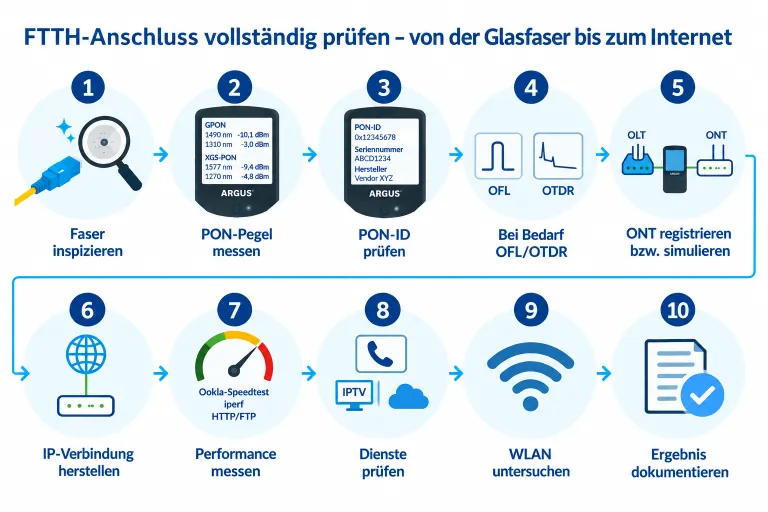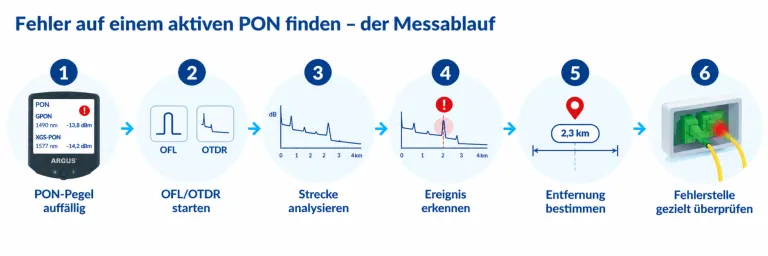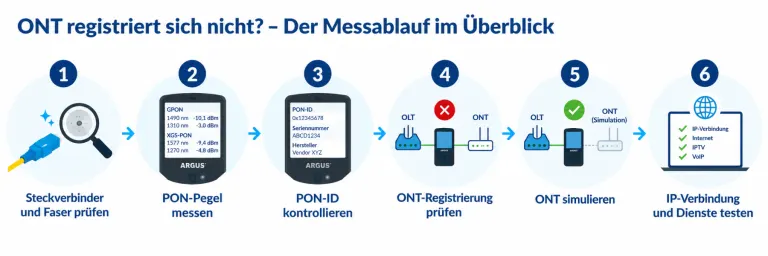
When carrying out acceptance testing on a GPON or XGS-PON connection, it is not sufficient simply to measure an optical level. The crucial factor is whether the measured value corresponds to the specific network structure in place and whether the technician is actually at the intended PON branch. The PON-FMT acceptance test in accordance with ZTV 43 is an automated test and measurement procedure for checking continuity and cross-connections, and for quality assurance of the Gf-AP right up to the OLT. In this process, the associated OLT port is identified via the PON ID and, at the same time, the insertion loss of the relevant wavelengths is determined. The ARGUS guides the technician through the measurement like an assistant, automatically calculates the expected target insertion loss and then evaluates the measurement result as OK or nOK. In addition, the PON-ID is determined to ensure that the measurement is carried out on the correct PON branch. No login to the OLT takes place during this process. The key advantage over a simple level measurement is that the technician does not merely receive a dBm value which they must interpret themselves. Instead, the measurement answers the crucial questions: Does this specific GPON/XGS-PON connection correspond to the expected attenuation, and has the correct fibre been measured?
What is a PON-FMT measurement in accordance with ZTV43?
The PON-FMT option is designed for measurements on GPON and XGS-PON connections in accordance with ZTV43. Rather than simply displaying the current optical level, the guided measurement procedure takes the existing network structure into account.
Based on the job and network data entered, ARGUS determines the target attenuation relevant for acceptance testing and the number of fibres to be measured. The measured value is then automatically compared with the calculated target value and assessed as OK or nOK.
The measurement can be saved and subsequently documented in a PDF acceptance report.
How does the PON FMT measurement work?
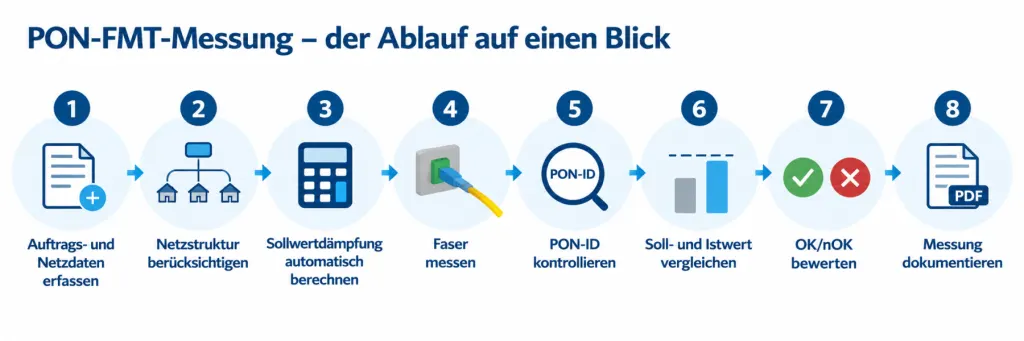
In simple terms, a PON-FMT measurement is carried out in the following steps:
Thanks to the guided procedure, the technician does not have to assess the measurement results themselves based solely on a single level value. The assessment is carried out taking into account the previously recorded network structure.
How is the target attenuation calculated?
First, the data relevant to the job is recorded. After selecting the Gf-AP type, details such as the number of residential units and the fibre length can be specified. Where there are multiple residential units, one or more couplers can also be taken into account.
Based on this information, ARGUS automatically determines the setpoint attenuation relevant for acceptance and the number of fibres to be measured.
Why is the PON ID determined during the measurement?
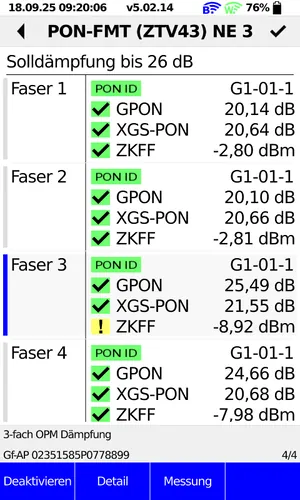
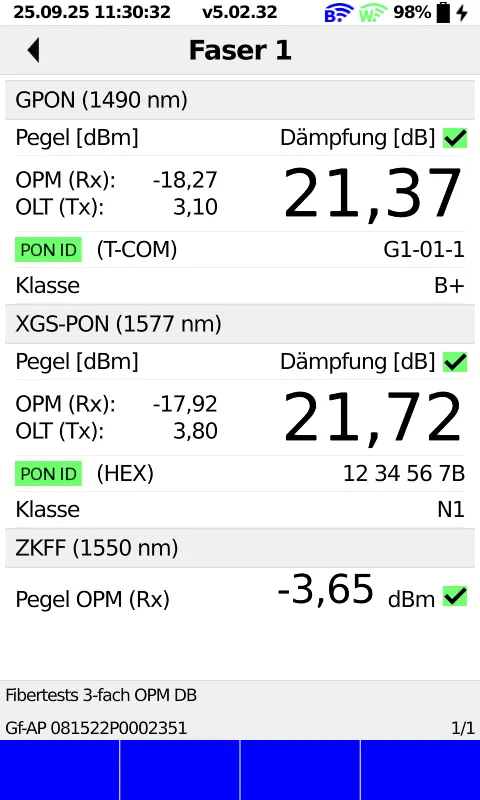
In addition to the optical level, the PON-ID is also determined during the PON-FMT measurement. This allows verification that the measurement is actually being carried out on the intended PON branch. Registration with the OLT is not required for this.
Particularly in the case of more complex PON structures, the measurement thus not only provides the information ‘signal present’, but also combines the signal level measurement with a verification of the PON branch and the calculated target attenuation.
What is the Level ID Test (PIT) according to ZTV 43?
In addition to the PON FMT acceptance test, ZTV 43 describes the Level ID Test (PIT). This involves determining and verifying the insertion loss for GPON at 1490 nm and – where applicable – for XGS-PON at 1577 nm at the Gf-AP. In addition, the associated OLT port is identified via the PON ID.
The PIT is therefore primarily used to check signal levels or insertion loss and the correct PON assignment. This allows potential OLT port mix-ups or deviations in insertion loss to be detected at an early stage.
Unlike the more comprehensive PON-FMT acceptance test, the PIT does not perform a target value calculation based on the entered network structure. The measured values for PON-ID, signal levels and attenuation are assessed for correctness against the specified requirements.
Which wavelengths are measured during PON-FMT?
During the PON-FMT acceptance test, the relevant optical levels and attenuation values can be recorded simultaneously. These include 1490 nm for GPON, 1577 nm for XGS-PON and – where available – 1550 nm for ZKFF/TV.
Which ARGUS testers support PON-FMT?
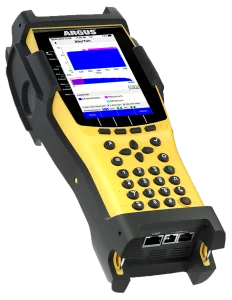
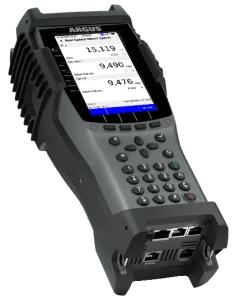
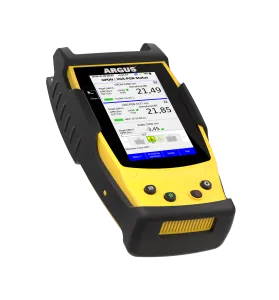
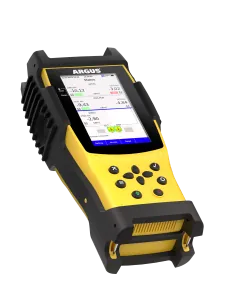
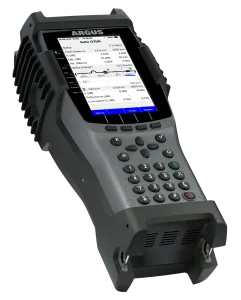
The current ARGUS testers with 3x, 4x or 5xOPM support the PON-FMT option. Depending on the OPM configuration, the F-series devices can measure GPON and XGS-PON; with the 5xOPM, they can also measure the 1550 nm level for ZKFF/TV.
ARGUS F200 | ARGUS F240 | ARGUS F300 | ARGUS 300 | ARGUS 260
How is the PON-FMT acceptance test documented?
Documentation is an integral part of the measurement process. Measurements can be temporarily saved and resumed at a later date.
The measurement results can be documented in a PDF acceptance report. Saved reports can, amongst other things, be copied to a USB stick, transferred via FTP or accessed via WLAN using the web interface, WebDAV or the ARGUS Mobile App.
This ensures that the measurement values, the automatic evaluation and the associated order data remain available in a traceable format even after the acceptance test has been completed.
This results in a reproducible acceptance process with traceably documented measurement results.
PON-FMT in accordance with ZTV43 at a glance
| Function | PON-FMT |
|---|---|
| Measurement procedure | Guided |
| Setpoint attenuation | Automatic calculation |
| Evaluation | Automatic OK/nOK |
| PON ID | Being determined |
| Registration at the OLT | No |
| GPON | 1490 nm |
| XGS-PON | 1577 nm |
| ZKFF/TV | 1550 nm, if available |
| GPON upstream | 1310 nm, depending on the equipment |
| XGS-PON upstream | 1270 nm, depending on the equipment |
| Documentation | including PDF acceptance report |
Technical data for level measurement
| Specification | Value |
|---|---|
| Accuracy | ±0.5 dB at -20 dBm |
| 3xOPM Measurement range | -40 to +6 dBm |
| 5xOPM measurement range | 5xOPM measurement range |
| 1550 nm range | -50 to +13 dBm |
| Documentation | including PDF, USB, FTP, WLAN/WebDAV/App |
Further information on PON-FMT and the ARGUS testers
For further technical details, please refer to the PON-FMT leaflet and the relevant product pages for the ARGUS testers.