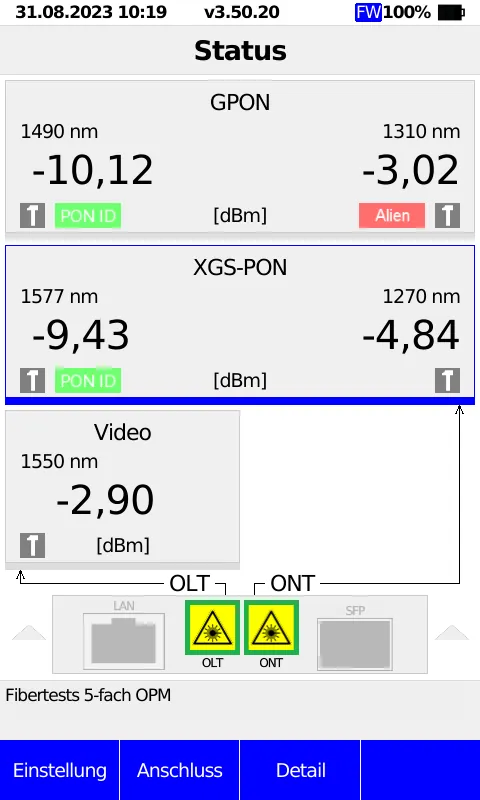
An optically low signal level at a GPON or XGS-PON connection initially only indicates that there is a problem – not where it is located. To carry out targeted fault-finding, the technician must therefore determine at which point along the fibre-optic link the abnormal attenuation or other anomaly is occurring. Is the cause directly at the connection point, at a connector or splice – or several hundred metres away along the feed line? Reflectometric measurement methods such as OFL (Optical Fault Locator) and OTDR (Optical Time Domain Reflectometer) are used to localise such faults.
How can a fault on a fibre-optic cable be pinpointed?
An OTDR sends an optical pulse into the fibre optic cable and analyses the backscattered and reflected signal components. Based on their intensity and transit time, events along the route can be identified and their distance from the measuring instrument determined.
Depending on the measurement, the following events, for example, can be localised:
- Connectors
- Splices
- Bends
- Notable attenuation events
- Fibre ends and fibre breaks
Reflectometric measurement therefore not only indicates that the signal level is too low, but also provides a specific indication of where along the fibre-optic link the cause should be sought.
Can I use an OTDR on an active PON?
In the case of an active PON, the measurement must be carried out in such a way that ongoing GPON or XGS-PON data traffic is not disrupted.
For such in-service measurements, a maintenance wavelength separate from the user signals can be used. 1650 nm lies outside the transmission wavelengths used for GPON and XGS-PON and can therefore be used for fault localisation on an active PON.
This allows the fibre-optic link to be examined whilst the PON remains in operation.
What is the difference between OFL and OTDR s when troubleshooting?
For a service engineer, a full analysis of a conventional OTDR curve is not required in every fault scenario. Often, two questions are crucial at the outset: What is unusual on the link? How far is this event from the measurement point?
This is where the Optical Fault Locator (OFL) comes in. It simplifies reflectometric fault location and processes detected events in such a way that the technician does not have to analyse a complex OTDR curve themselves.
A full-featured OTDR, on the other hand, offers greater depth of measurement and analysis and is suitable when events on the fibre-optic link need to be examined and assessed in greater detail.
Find out more: OFL or OTDR – which measurement method do I need for FTTH?
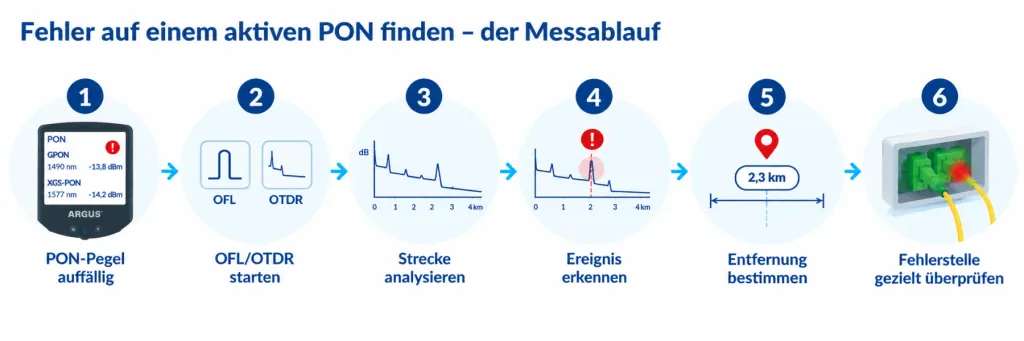
How does fault location work on an active PON?
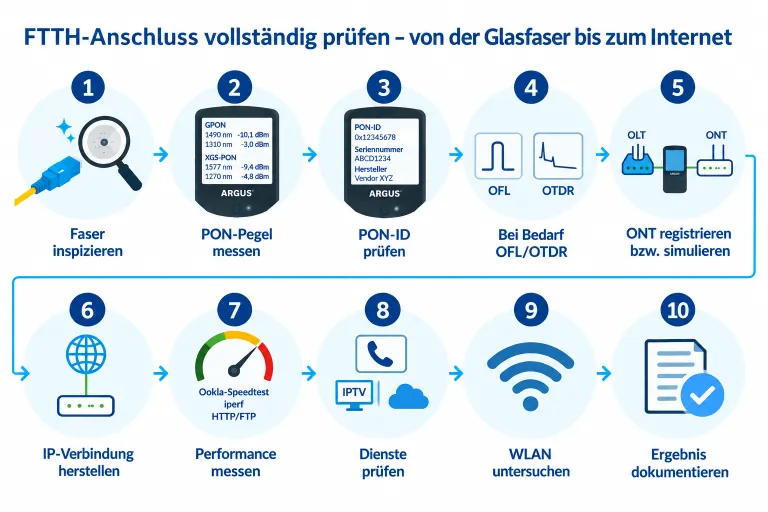
The typical procedure can be broken down into a few simple steps:
Rather than checking several splitters, connectors or other potential fault locations one after the other, the technician thus receives a specific indication of the distance at which an anomaly lies on the fibre-optic link.
Which ARGUS testers are suitable for fault location?
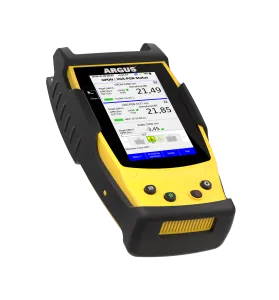
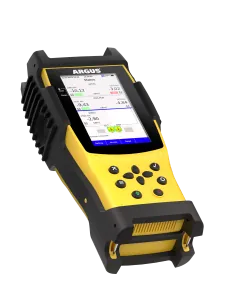
For typical service calls, the ARGUS F200 and ARGUS F240, equipped with the Optical Fault Locator (OFL), can be used to simplify fault localisation.
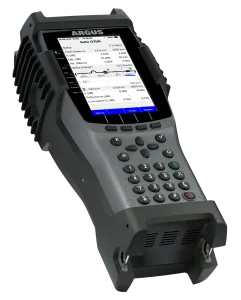
The ARGUS F300 features a fully-fledged OTDR for more detailed measurements. This allows events on the fibre-optic link to be localised and analysed in greater depth.
The key benefit for fault clearance: the observation ‘The optical level is too low’ is transformed into much more specific information: ‘The anomaly is located at this distance along the fibre-optic link.’